

he Certificate in Succession Planning is a strategic and future-focused program designed to help HR professionals and business leaders build strong talent pipelines and ensure leadership continuity within organizations.
Succession planning is a critical HR strategy that focuses on identifying and developing internal talent to fill key leadership and critical roles in the future. It helps organizations maintain stability, reduce risk, and ensure long-term business success by preparing employees to step into higher responsibilities when required.
In today’s competitive and rapidly changing business environment, organizations cannot afford disruptions due to sudden leadership gaps. This course provides a structured approach to building effective succession plans, identifying high-potential employees, and preparing them for future leadership roles.
A key highlight of this program is its focus on practical implementation of succession planning strategies, including talent identification, leadership development, and workforce planning. Learners will gain insights into how organizations create sustainable talent pipelines and align succession planning with business goals.
The course also emphasizes strategic HR thinking, helping learners connect talent management with organizational growth, performance, and long-term success.
Through real-world scenarios, practical frameworks, and industry best practices, this program equips learners with the skills required to design and implement effective succession planning strategies.
By the end of this course, participants will be able to build strong succession plans, develop leadership pipelines, and contribute to organizational continuity and growth
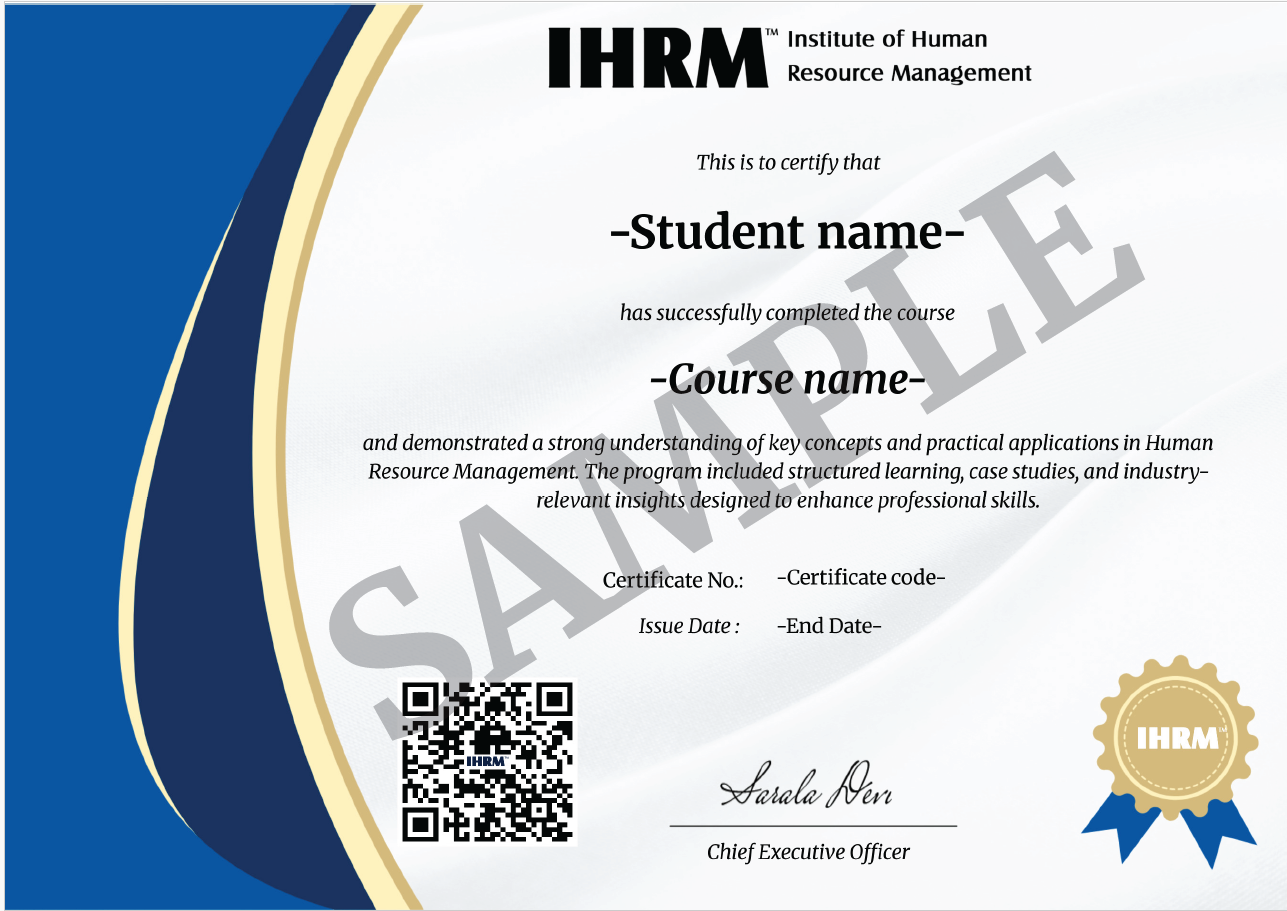
Certification:
Upon successful completion of the course, participants will receive a:
👉 Please find below the Sample Certificate of Completion
Explore more HR courses at https://www.ihrmonline.com/courses/
-
7
 Identifying key positions that are critical for Succession Planning
 -
8
Defining the essential competencies required for
-
9
Understanding role-specific nuances in succession planning
-
10
Using job analysis to create accurate competency models for succession planning
-
11
Case study Examining competency-based succession planning
-
12
Integrating succession planning with overall business
-
13
Aligning succession plans with organizational goals
-
14
Balancing short-term needs with long-term strategic succession planning
-
15
How succession planning supports organizational agility and competitive advantage
-
16
Real-world examples Aligning succession planning
-
17
Recognizing and evaluating high-potential talent within the organization
-
18
Using performance reviews and assessments in talent identification processes
-
19
Leveraging data-driven approaches to identify future leaders and key contributor
-
20
The role of management and leadership input in identifying potential successors
-
21
Case studies Successful talent identification practices in leading organization
-
27
Designing tailored development plans
-
28
Developing strategies to ensure diverse representation
-
29
Addressing unconscious bias in talent identification
-
30
Providing ongoing feedback and performance management
-
31
Developing rotational programs to broaden potential lead
-
32
Examples of effective development programs
-
33
Understanding the importance of diversity done
-
34
Developing strategies to ensure diverse representation in succession pipelines
-
35
Addressing unconscious bias in talent identification and assessment processes
-
36
Creating inclusive development opportunities for underrepresented groups
-
37
Case studies Diversity and inclusion best practices in succession planning
-
69
Adapting succession planning to accommodate global talent
-
70
Navigating cultural differences in talent identification and development
-
71
Implementing global succession planning strategies
-
72
Balancing local and global talent needs in multinational succession plans
-
73
Case studies Successful global succession planning
-
79
Developing specialized strategies for executive and CEO
-
80
Balancing internal promotion versus external hiring
-
81
Ensuring a smooth leadership transition during executive succession events
-
82
Engaging boards and external stakeholders
-
83
Real-world case studies High-profile CEO succession planning